Walking Osaka's Contemporary Galleries: Nakanoshima and Beyond
Between the rivers that bracket Nakanoshima, where Osaka's civic architecture meets its quieter commercial streets, a handful of galleries have been reshaping what contemporary art means outside Tokyo.
The light on Nakanoshima arrives from two directions. The Dojima River to the north and the Tosabori River to the south throw it back and forth across the island's surface, so that by mid-afternoon the sandstone facades of the old civic buildings seem to hold a warmth that has nothing to do with the season. This is Osaka's formal center — the district of public halls and central libraries, of banks built when the city still called itself the Manchester of the East. But formality, in Osaka, has always been a thin layer over something looser and more improvisational. Step off the main avenue, cross one of the smaller bridges, and the grid relaxes. The towers pull back. The streets narrow and the signage gets older, and you begin to notice doors at street level that do not quite match the buildings above them — entrances that have been opened, closed, and reopened enough times to carry the sediment of several different purposes.
This is where Osaka's contemporary art scene lives. Not in a dedicated quarter, not behind the velvet rope of a museum district, but woven into the commercial fabric of blocks that still function as offices during the day and empty out at dusk. The galleries here do not announce themselves with banners or architectural statements. They occupy second floors, top floors, converted retail spaces. Finding them requires a certain willingness to climb a staircase you have no prior reason to climb. And that small act of commitment — choosing to enter rather than wandering in — changes the terms of what you see inside.
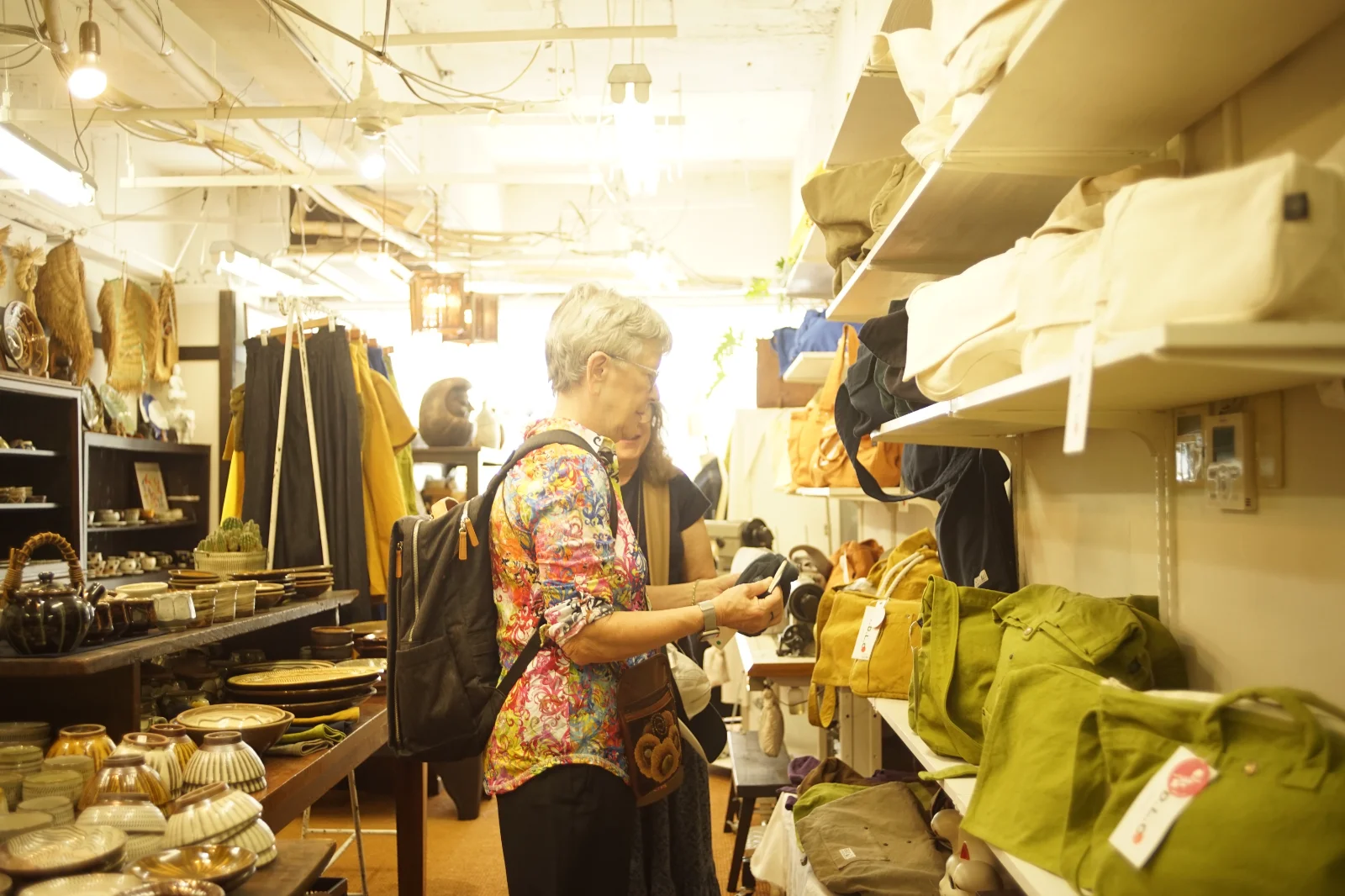
The walk begins west of the island, in a neighborhood where the line between craft and contemporary art has been drawn and redrawn so many times that most people here have stopped trying to draw it at all. Komanogu, operating under the name V.D.L.C., occupies this territory with a focus on Japanese textiles and functional art — objects that sit at the intersection of daily use and material intelligence. The question it raises is one that recurs throughout this part of Osaka: what happens when an object made to be used is given the same attention as an object made to be looked at? In a city whose manufacturing heritage runs from Sakai knives to Senshu towels, the answer is less theoretical than it sounds. Craft-adjacent spaces like this one matter because they keep the conversation between hand and eye open — a conversation that the white-cube model of contemporary art tends to foreclose.
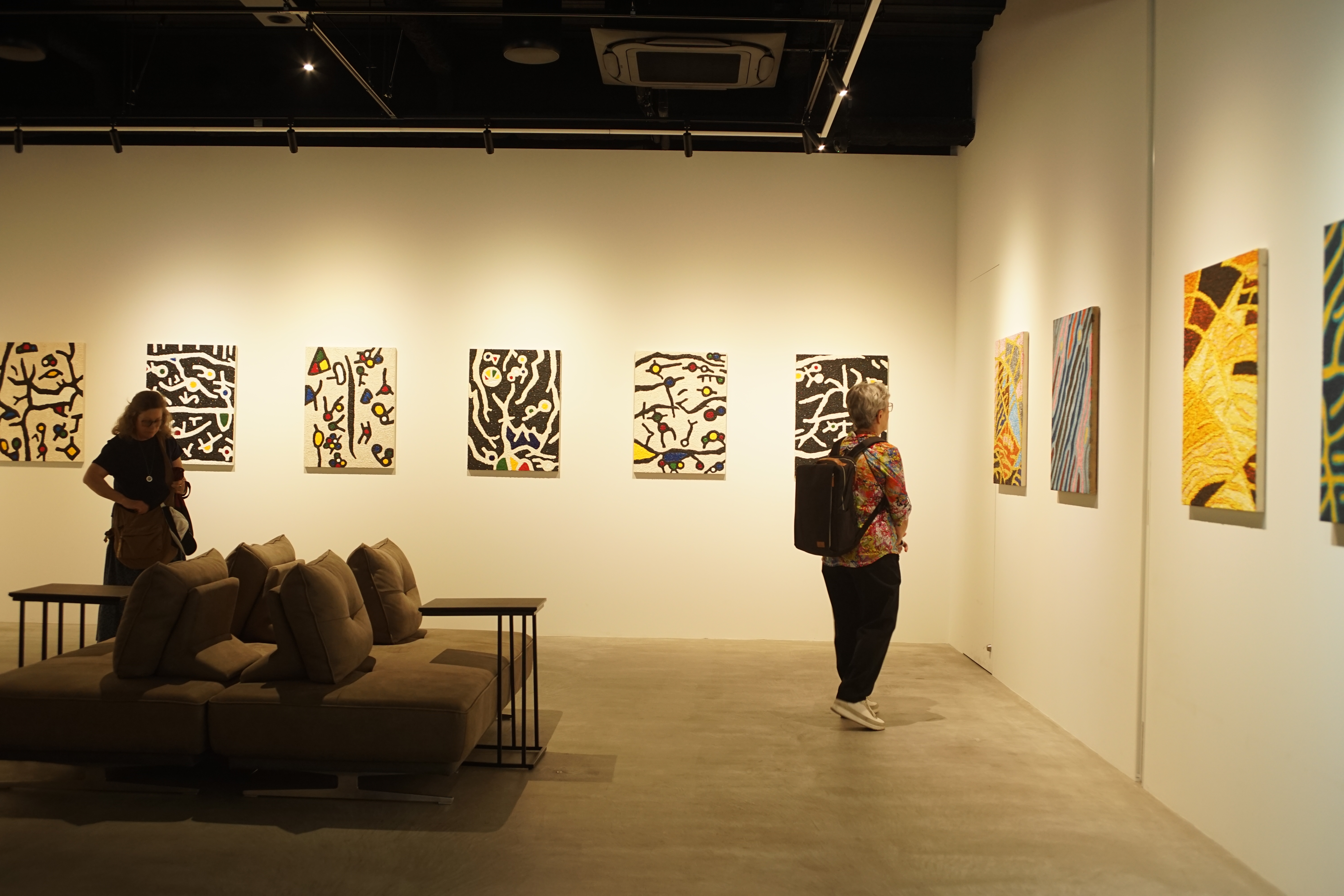
From here, the walk turns east toward BALC, an experimental gallery whose program operates on principles that would make a commercial dealer uneasy. BALC has positioned itself at the edge of what galleries typically do. Its "Drawing on the Wall" project — an ongoing invitation for artists to work directly on the gallery's surfaces — collapses the distinction between exhibition and residency, between the work and the space that holds it. In a scene where most galleries maintain the careful neutrality of white walls and track lighting, BALC lets its walls become participants. When we visited, SOONJAE's solo exhibition "YUME NO KIROKU / ゆめのきろく" occupied the room — work built from fingerprints and palm prints, materials so specific to a body that no two pieces could come from the same hand. SOONJAE's process layers charcoal sketches with ink-dampened fabric, then applies mortar, adhesive, cement, building surfaces that carry the rough grain of cave walls. Pigment comes last, its colors drawn from daily life and from dream states, so that each painting holds both at once. He describes the work as "a dream-like device that records the entire process toward identity" — past, present, and future coexisting on a single surface. Standing in front of the pieces, time did not feel sequential. It felt geological, compressed into strata you could almost read with your fingers. What "experimental" means in Osaka's context is less about formal novelty than about institutional nerve — the willingness to let the gallery itself be changed by what happens inside it.
A short walk along the river leads to The Third Gallery Aya, and the register shifts. Where BALC operates on instinct, Third Gallery Aya operates on conviction — the particular conviction that Osaka's art audience deserves the same international programming that Tokyo takes for granted. The gallery has built its reputation by bringing artists whose work circulates through European and North American institutions into a city that the global art circuit has historically treated as a waypoint between Tokyo and Naoshima. When we visited, the gallery was showing スクリプカリウ落合安奈 (Ana Scripcariu-Ochiai), an artist whose dual Japanese-Romanian roots give her work a specific gravity around the question of land and belonging. The exhibition presented photographs from a year-long stay in Romania — people, faith, nature, land captured on film during fieldwork that was as much cultural anthropology as it was art-making. What made the show significant was what it marked: Scripcariu-Ochiai had previously shown through slide projector installations, letting images flicker and dissolve in projected light. This was her first solo photography exhibition — the images fixed, printed, still. The transition carried weight. A portfolio of five prints, housed in a special box, sat on a table near the entrance, each one dense with the particularity of a place most visitors to an Osaka gallery would never see. Separately, her recent work in primatology — prints from an entirely different field of looking — suggested an artist whose range refuses the boundaries that galleries find convenient. Third Gallery Aya is a commercial gallery in the full sense of the term — it sells work, it represents artists, it attends to career arcs. But in Osaka, where the infrastructure of commercial galleries is thinner and the collector base more cautious than in the capital, sustaining that model over years requires a stubbornness that functions, in practice, as a form of civic investment.
The relationship between Osaka and Tokyo recurs like a bass note throughout any conversation about art in this city. Tokyo's scene is market-driven — powered by collectors, auction houses, art fairs, and the gravitational pull of money seeking cultural legitimacy. Osaka's scene is community-driven, which sounds warmer than it is. What it means, practically, is that galleries here survive not on sales volume but on relationships — with artists, with the small circles of collectors who buy out of genuine attachment, and with each other. The clustering of galleries near the rivers is not accidental. Nakanoshima has been Osaka's civic and cultural spine since the early twentieth century — the National Museum of Art sits on the island's western edge, the public hall anchors its center, and the prefectural library holds down the east. Galleries settled nearby the way smaller fish settle near a reef: not because the reef feeds them directly, but because the ecosystem it supports makes the surrounding water habitable.
Calo Bookshop & Cafe is proof of that ecosystem. Perched in the Wakasa Building, Calo has been operating since 2004 as something that resists a single label: part bookshop, part gallery, part cafe where the curry has become known among people who pay attention to such things. The bookshop-gallery hybrid is not unique to Osaka — you can find versions of it in Amsterdam, Seoul, São Paulo — but Calo's particular chemistry is hard to replicate. The shelves stock what commercial bookstores cannot justify: exhibition catalogs in editions of three hundred, photography monographs from presses that may have published four titles total, artist-made zines assembled by hand. The logic is curatorial rather than commercial. If you want to understand what is being made and thought about in Kansai's art scene at any given moment, an hour here, pulling books from shelves, will tell you more than a week of gallery-hopping. The curry is beside the point and also, somehow, not.
Walking south from Calo, you cross back toward the island's center, and the Osaka City Central Public Hall appears on your left — a 1918 Neo-Renaissance building that survives from the era when Osaka was Japan's largest city and spent accordingly. The public hall was funded by a single stockbroker's donation, a gesture of civic ambition so outsized it ultimately cost him his fortune. The building remains, copper dome gone green, a reminder that the cultural infrastructure of this district was not planned by committees but willed into existence by individuals who believed a city should look like what it aspired to be. That spirit — personal, slightly reckless, more interested in legacy than return — is not a bad description of what keeps many of the galleries in this area open.
LADS Gallery has been open since 1988. In a neighborhood where gallery leases turn over with the rhythm of the broader economy, thirty-eight years in the same location is not persistence so much as a statement of purpose. LADS's sympathies reach back toward the Gutai movement — the postwar collective that insisted the act of making was itself the work, that a canvas torn open or a body hurled through paper was not preparation for an image but the image entire. Gutai dissolved decades ago, but something of its restlessness persists in the artists LADS chooses to show. When we visited, 川井ミカコ (Mikako Kawai) had filled the room with "終わらない手紙" (Never-ending Letter) — part of a series called "Being on the Shore of Art's Great Surge," its first volume organized around a single material: iron plate. Past and new works hung together, sorted not by chronology but by the substance they were made from, as if the material itself were the organizing intelligence. Iron has a particular way of holding time — it rusts, it darkens, it records the air it has lived in — and Kawai's decision to let the medium dictate the exhibition's logic felt consonant with a gallery that has always trusted the work to know more than the wall text. The gallery has consistently maintained bilingual programming, a practical decision that doubles as a philosophical one: the assumption that the work will find its audience across languages, that what happens in a room in Osaka belongs to a conversation larger than any single city. Longevity in this scene means something specific. It means surviving the collapse of the bubble economy, the long deflation that followed, the pandemic, and the structural indifference of a global art market that has never quite decided whether Osaka matters. To still be here, still showing work, still keeping the lights on — that is the exhibition.
The walk to YOD Gallery crosses into Minamimorimachi, north of Nakanoshima, where the buildings press closer together and the streets carry a different energy — more residential, more worn in. YOD has built its program around emerging Japanese contemporary talent, which sounds like a standard gallery mission statement until you see how they execute it. The exhibition on view when we visited was「名前のない部屋」(The Nameless Room) — a group show that began with a deceptively simple proposition: what happens when you strip names and meanings from the spaces and objects we use to organize the world? The premise was not theoretical decoration. The gallery had been reconceived as a space before meaning is born — a temporary reversal of the naming that normally lets us navigate rooms, categorize objects, assign purpose. Multiple art forms intersected in the installation: work you might call sculpture shared walls with work you might call photography, but the exhibition's logic discouraged those labels. Without fixed answers, the room became a margin — a place for looking at things that are invisible or ambiguous under ordinary conditions. Each viewer's movement through the space raised different questions, and those questions, rather than the objects themselves, were what the show generated. It was the kind of exhibition that trusted its audience to sit with uncertainty rather than reach for interpretation, and gave the artists room to be contradictory, provisional, and unresolved.
The rivers darken before the sky does. Walking back along the Tosabori toward the train station, the galleries behind you are already closing or have closed — most keep early hours, timed to the rhythm of a district that empties when the offices do. The water holds the last of the light in long, shifting planes that do not stay still long enough to photograph.
What stays is not a list of works seen or spaces entered. It is something closer to a quality of attention that the afternoon has produced — the sense that each gallery proposed a different relationship between what is made and who stands before it, and that the walk between them was not empty time but part of the same conversation. Osaka's contemporary art scene does not ask you to arrive with opinions. It asks you to arrive with patience, and with a willingness to let a room change the way you think about the room you were in before. Whether that constitutes a scene, a movement, or simply a handful of people keeping faith with something difficult to name — that is a question these galleries have been answering, without fanfare, for decades. They are still answering it.
Interested in exploring these galleries with a local guide?
Koh Yoshida, a certified Osaka tour guide and the curator behind ArtRoute, offers private art gallery tours covering the areas in this article.
Book a Guided Art Tour →Via Viator · Private tour